
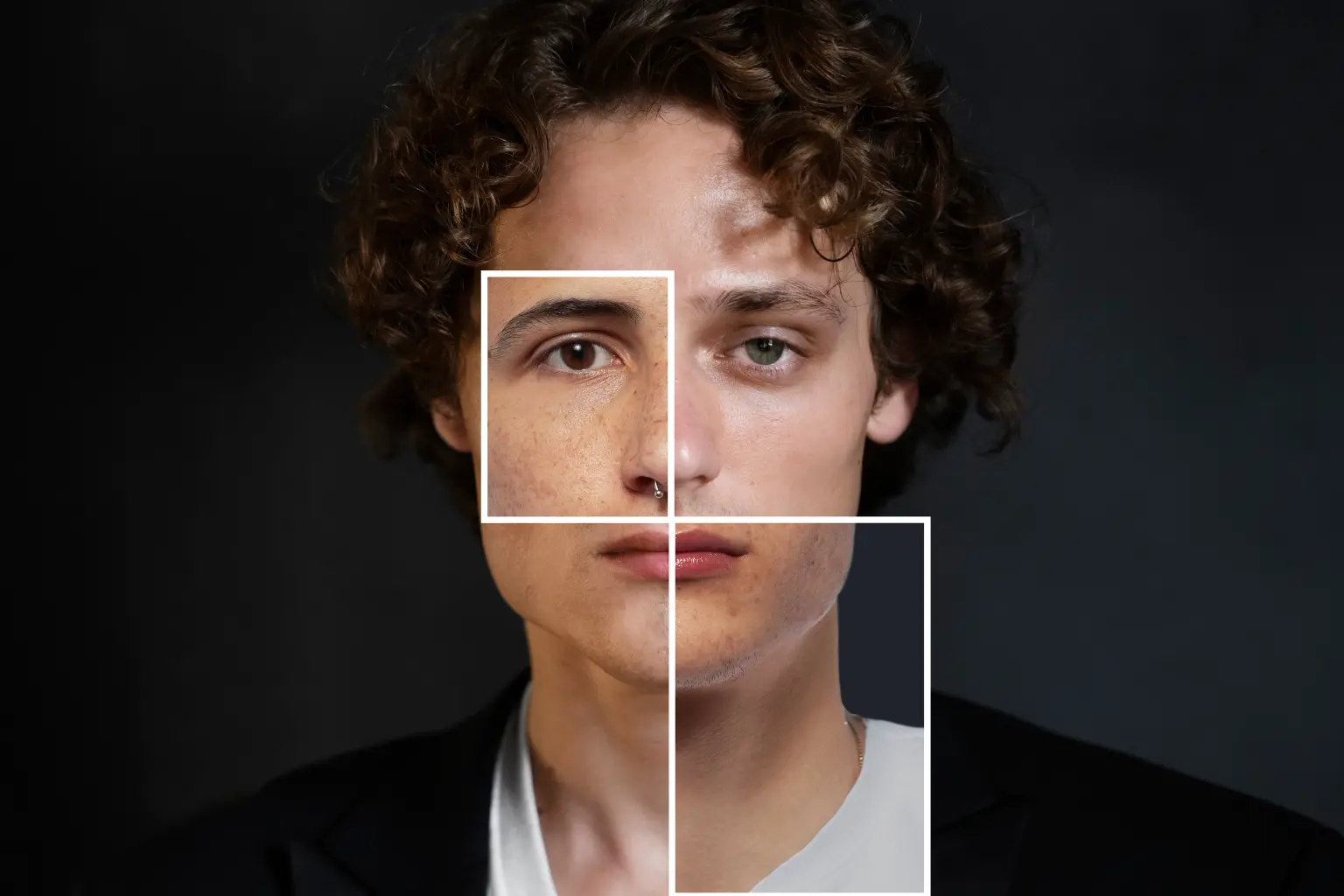
The idea of achieving a “golden ratio face” is often discussed in relation to facial proportions, symmetry, and balance. While the golden ratio is a mathematical concept used to describe proportional relationships, it is not a formula for changing facial structure or appearance.
This guide explores what the golden ratio represents in facial analysis, how science interprets facial proportions, and which factors influence how faces are perceived. Rather than offering guarantees, this article provides a realistic, evidence-based perspective on what can and cannot be influenced.
A Quick Reality Check Before You Continue
Facial proportions are influenced by genetics, bone structure, and natural variation. While certain habits, styling choices, or professional options may influence appearance, there is no proven method to transform a face to match an exact mathematical ratio. The golden ratio should be viewed as a reference framework, not a goal.
What Is the Golden Ratio Face?
Well, it’s a special number. Mathematicians call it “Phi.” It’s roughly equal to 1.618.
It appears in nature. You see it in seashells, flower petals, and hurricane patterns. For centuries, artists and architects have used it. They used it to create art and buildings that feel naturally pleasing to the eye.
The golden ratio face applies this math to human features. The idea is pretty much simple. When the proportions of your face match ratios close to The closer the result is to 1.618, the closer it is to the golden ratio.
How to Measure Your Golden Ratio Face?
Before you try to “get” it, you need to understand it. How do you measure it? You don’t need to be a math genius.
The Basic Theory of Face Mapping
Researchers use specific points on the face. They measure the distances between them. Then they divide one length by another. The closer the result is to 1.618, the closer it is to the golden ratio.
Common measurement pairs include:
- The width of the mouth to the width of the nose.
- The distance between the pupils to the distance between the eyebrows.
- The length of the face from hairline to chin, compared to its width.
A Simple Way to Calculate Your Phi
You can try a basic version at home. You will need a straight-on photo and a ruler tool (like in photo editing software).
Measure Face Length and Width. Measure from the top of your forehead (hairline) to the bottom of your chin. This is the length. Then measure across the widest part of your cheeks. This is the width.
- Do the Division. Divide the length by the width. Formula: Face Length / Face Width.
- Interpret the Result. A number that is pretty close to 1.6 suggests a “golden” proportion. But remember, this is just one ratio.
- For a full analysis, scientists use many more measurements. This is where a golden ratio calculator for the face comes in. These are apps or software that map dozens of points automatically. They give you an overall score.
Important:
Don’t stress over a perfect 1.618. Attraction is subjective. These tools are for curiosity, not a report card on your worth.
A Critical Look at the Science: What a Dental Journal Really Says
You’ll find many sources online that talk about the golden ratio. Some are solid, others are less reliable. Let’s spot the variations in one example. A 2024 article titled “Beauty beyond numbers: The golden ratio and facial aesthetics” was published in The Journal of Dental Panacea, a peer-reviewed dental journal.
This gives us a perfect case study. It shows the usage of concept in professional field.
So, What Does The Study Support?
The article, written by dental professionals, actually vouches several key ideas from our guide.It states the golden ratio is used as a “theoretical framework” in dentistry and surgery to assess facial harmony.This matches our view of it as a blueprint, not a rule. It provides complex clinical measurement ratios (like mouth width to nose width). This projects the depth of analysis in professional aesthetic planning.
Most importantly, it strongly agrees that beauty is subjective. The authors note that cultural and individual preferences make a universal standard “complicated” and “debatable.”
Factors That Influence Facial Balance and Proportions
Here is the core of the guide. You cannot change your bone structure without surgery. But you can enhance your proportions. You can create the illusion of better balance. These methods are backed by dermatology and cosmetic science.
Master Contouring and Strategic Makeup
Makeup is the overall non-invasive tool. It uses light and shadow to reshape your face.
Science:
Dark colors recede. Light colors bring forward. You can shorten a long forehead. You can widen a narrow jaw. You can make a nose appear slimmer.
Action:
Identify the ratios you want to tweak. Is your face very round (low length-to-width ratio)? Contour the sides to create shadow. Highlight the center to lengthen. This can nudge the perceived ratio.
Focus on Skin Health and Volume
Youthful, full skin contributes to ideal proportions. As we age, we lose facial fat and collagen. This can make features look disproportionate.
Science:
Studies show that skin elasticity is a key factor in attractiveness. They provide solid structural support.
Action:
Use proven skincare ingredients. Retinoids boost collagen. Hyaluronic acid plumps the skin. Sunscreen prevents collagen breakdown. Healthy, hydrated skin sits better on your frame.
Consider Non-Surgical Professional Treatments
These are more advanced steps. They involve a cosmetic dermatologist.
Dermal Fillers:
Fillers based on hyaluronic acid add volume. A skilled injector can place tiny amounts to balance proportions. For example, a little filler in the chin can better balance a prominent nose. This adjusts the “phi” between features.
Botox:
It relaxes muscles. It can lift a drooping brow. It can soften a square jaw. This subtly changes the shape and proportions of facial zones.
The Role of Posture and Symmetry
This is the easiest win. The golden ratio depends on a straight-on view.
Science:
Asymmetry is normal. But pronounced asymmetry is less appealing. Good posture aligns your face properly.
Action:
Be mindful of phone posture. And, yeah, never sleep on the same side. Practice good neck and shoulder alignment. This ensures your natural proportions are presented correctly.
The Crucial “Yes, But…” of Science:
However, a smart reader looks at how a study says something. The title itself, “Beauty Beyond Numbers,” gives away the conclusion. It also raises some pretty serious ethical warnings. It questions whether chasing this single ideal through surgery or filters promotes unrealistic standards and reduces the wonderful diversity of human faces.
What to Take Away From Facial Proportion Research
Chasing a perfect mathematical face is a fool’s errand. Even the celebrities used as examples don’t hit 1.618 on every single measurement. The real goal is facial harmony.
When you work on your skin, when you style your hair and beard well, when you use makeup smartly, you are enhancing your unique harmony. You are moving toward the principles of balance that the golden ratio describes. It is a blueprint, not a cage.
